Ever wondered how your phone seems to read your mind, suggesting the perfect playlist or rerouting you around traffic before you even notice the jam? Or why your feed is flooded with ads that feel eerily spot-on?
That’s AI at work, quietly revolutionizing your daily grind. Today, AI isn’t some futuristic sci-fi trope – it’s embedded in everything from your morning commute to your late-night binge-watching.
According to recent surveys, 61% of American adults have used AI in the past 6 months, with nearly 1 in 5 relying on it every single day. [link] Scaled globally, that translates to 1.8 billion people using AI tools, with 600 million engaging daily.
But why should you care?
Understanding AI demystifies the tech that’s shaping your choices, helps you spot biases, and empowers you to use it smarter – whether dodging privacy pitfalls or unlocking new efficiencies.
In this post, we’ll break it down with real-world examples, starting from the basics and diving into powerhouse tech like Large Language Models (LLMs), recommendation engines, and navigation apps. By the end, you’ll see AI not as a black box, but as your invisible sidekick. Let’s dive in.
Everyday AI Examples: How It’s Already Enhancing Your Routine
AI is like that reliable friend who’s always one step ahead, processing mountains of data to make your day smoother. Here are some everyday examples to make it clear:
- Smartphone Virtual Assistant (e.g., Siri, Google Assistant): When you ask, “What’s the weather today?” your phone listens, processes your voice, and retrieves real-time weather data. AI powers the speech recognition, natural language understanding, and response generation.
- Recommendation Systems (e.g., Netflix, Spotify): When Netflix suggests a show or Spotify curates a playlist, AI analyzes your viewing or listening history, compares it with patterns from millions of users, and predicts what you’ll like.
- Navigation Apps (e.g., Google Maps, Waze): When you use GPS to find the fastest route, AI processes traffic data, road conditions, and user reports in real time to optimize your path and suggest detours if there’s a jam.
- Spam Filters (e.g., Gmail): Your email app automatically sorts junk mail into the spam folder. AI learns from examples of spam emails, user flags, and patterns (like suspicious links) to filter out unwanted messages.
- Facial Recognition (e.g., unlocking your phone): When your phone unlocks with a face scan, AI compares your face to a stored model, analyzing features like eye distance or jawline, even in different lighting or angles.
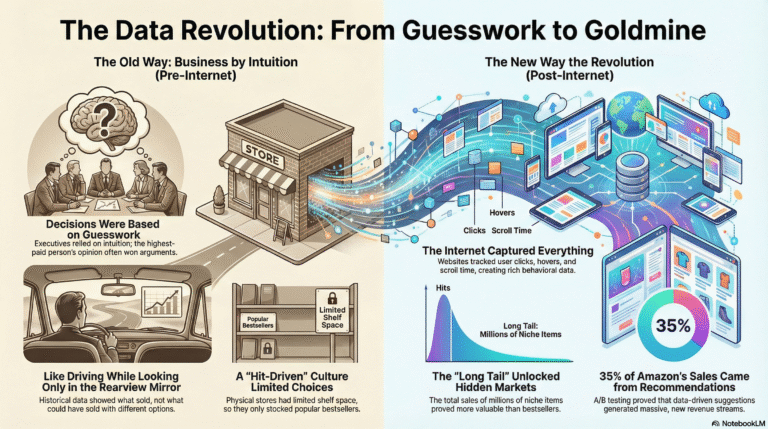
- Online Shopping (e.g., Amazon): AI drives product recommendations such as “Customers also bought…” by analyzing your browsing history, purchases, and trends across other shoppers. It also powers chatbots for customer service.
- Voice-to-Text (e.g., dictation on your phone): When you dictate a text message, AI converts your speech to text by recognizing patterns in sound waves and mapping them to words, even handling accents or background noise.
- Smart Home Devices (e.g., Nest Thermostat): A smart thermostat learns your schedule and preferences, adjusting the temperature automatically to save energy while keeping you comfortable, using AI to predict patterns.
Deep Dive: Large Language Models (LLMs) and Their Applications
Now, let’s zoom in on LLMs, the brainiacs behind much of today’s AI magic.
Large Language Models (LLMs) are a type of AI designed to understand and generate human-like text by processing vast amounts of data. They’re built on “neural networks” trained to predict and produce language based on patterns in text.
LLMs are trained on massive datasets such as books, articles, code, and social media to learn grammar, context, and facts. They break down your input into tokens – words or phrases, analyze context, and predict the most likely response. For specific tasks like translation or coding, LLMs are further trained – fine-tuned – on specialized data to improve accuracy.
These models are not perfect; they have certain limitations. For example, they can sometimes misinterpret nuanced queries, generate outdated info, or produce “hallucinations”.
Hallucinations occur when an AI generates incorrect, fabricated, or unsupported information, often because it relies on patterns in its training data rather than verified facts. Remember when ChatGPT hallucinated a fake news story?
Think of an LLM as an incredibly eager-to-please intern. It’s brilliant and has read everything, but it would rather make something up than admit it doesn’t know the answer. That’s why you can’t blindly trust it for factual information. Remember to always fact-check!
Here’s how fine-tuning and real-time data access fix that:
Fine-tuning involves further training a pre-trained AI model on a smaller, specialized dataset to improve its performance for specific tasks or domains. This process helps reduce hallucinations by aligning the model’s outputs more closely with accurate, context-specific information.
Similarly, real-time data access allows an AI to fetch and incorporate up-to-date information from external sources during operation, rather than relying solely on static training data.
So while fine-tuning builds a strong, specialized foundation, ensuring the model starts with accurate, task-relevant knowledge, real-time data access keeps the model current, filling in gaps that fine-tuning alone can’t address, like sudden changes in traffic or new road closures.
Some examples of LLM applications are:
- Chatbots and virtual assistants (Grok, ChatGPT, Gemini, Claude): These models draw on its training data from books, websites, etc. to understand and generate a coherent response to your question.
- Writing assistance (Grammarly, Microsoft Copilot): The LLM analyzes your text, compare it to language rules and styles it’s learned, and offers improvements or completions. It can mimic tones (formal, casual) based on context.
- Translation services (Google Translate, DeepL): The LLM recognizes patterns in multilingual datasets, mapping words and grammar between languages while preserving meaning.
- Content creation (AI blog writers, Jasper, Copy.ai): The model pulls from its knowledge of web content, structuring an article with an intro, headings, and facts, mimicking human writing styles.
- Customer support automation (Zendesk AI, Intercom): The model is trained on customer service logs, understanding common queries and generating polite, accurate replies in real time. E-commerce sites use these LLM applications to handle basic inquiries such as refund policies, freeing up staff for complex issues.
- Code generation and debugging (GitHub Copilot, Replit): Trained on code repositories, the model understands syntax and programming patterns, predicting and generating functional code snippets.
- Education and tutoring (Duolingo, Khan Academy’s AI tools): The model draws on educational content, breaking down complex topics into simple terms or generating practice questions based on the subject.
- Search engine enhancement (Google’s AI Overviews, Perplexity): The model processes search queries, retrieves relevant data from the web, and generates concise, readable summaries instead of just links. For example, you search “best budget smartphones 2025”, and the LLM summarizes top models, pulling from reviews and specs.
Take Control Tips
Treat LLMs like a brainstorming partner, not an encyclopedia. To get the best results, give them a role and context. For example, instead of asking “Write about marketing”, try “You are a marketing expert writing a blog post for small business owners. Give me 5 creative ways to market a new coffee shop on a small budget.” This context helps the AI give you more relevant and useful answers, but always remember to fact-check any specific claims it makes.
Recommendation Engines: How Netflix and Spotify Seem to Read Your Mind
Have you ever finished a show on Netflix and been served the perfect recommendation for what to watch next? Or has Spotify created a playlist that feels like it was handcrafted just for you? That’s the work of recommendation engines, a powerful form of AI designed for the art of prediction.
Recommendation engines are AI systems that analyze data to suggest items, services, or content tailored to your preferences. They’re a subset of AI, often powered by “machine learning” or “large language models”, that predict what you’ll like based on patterns in your behavior and data from others.
They gather data like your past choices, ratings, purchases, browsing history, or even demographic info. Using algorithms like collaborative filtering, content-based filtering, or hybrid approaches, they identify patterns or similarities between users and items.
Collaborative filtering recommends items based on what other people with similar tastes or behaviors have liked. It’s like asking a friend with similar movie tastes what to watch next. The system looks at your past actions – what you eatched, bought, or rated – and compares them to other users’ actions. It then suggests items that similar users liked but you haven’t tried yet.
Content-based filtering recommends items similar to ones you’ve liked, based on their features or characteristics. It’s like picking a new book because it’s by the same author or in the same genre as one you enjoyed. The system looks at the details or content of items you’ve liked, like their genre, keywords, or attributes. It finds other items with similar details and suggests them.
The system then ranks items by how likely you are to engage with them and suggests the top matches. The engine refines its suggestions over time as it gets more data about your preferences.
Recommendation engines make life more convenient by cutting through information overload, helping you discover relevant content, products, or opportunities. But they can sometimes trap you in a “filter bubble”, showing only what aligns with past behavior. Ever feel like you’re in a digital echo chamber, where Spotify only plays slight variations of the same five bands? That’s the “filter bubble”, and the AI built it just for you. Understanding how it works is the first step to breaking out.
For example, streaming services like Netflix or Spotify use collaborative filtering to look at what users with similar tastes watched or listened to, while content-based filtering matches shows or songs based on genres, themes, or artists you’ve enjoyed.
E-commerce apps like Amazon or eBay analyze your purchase history, items you’ve viewed, and what others bought alongside similar products. Amazon shows “Frequently bought together” items or suggests a phone case after you buy a smartphone.
The engine in social media apps like Instagram or TikTok tracks your likes, shares, watch time, and interactions. It then uses a mix of collaborative filtering – what similar users like – and content analysis, such as video tags and captions, to display the “For You” page showing videos you’re likely to watch.
Online advertisers such as Google Ads and Facebook Ads use your search history, clicks, and website visits to predict products you’re interested in. It might combine this with demographic data such as age and location to target ads more effectively. For example, after browsing travel blogs, you get ads for luggage brands tailored to your budget and style preferences.
Job platforms such as LinkedIn and Indeed analyze your profile, including your skills, experience, job applications, and searches to match you to roles with similar requirements or ones applied for by users with comparable backgrounds.
Take Control Tips
Confused why Netflix is only showing you the same type of shows? Intentionally watch something completely different or use the “Rate” feature to give a thumbs-down to things you don’t like. You’ll actively retrain the algorithm to broaden your recommendations.
AI-Powered Navigation: Your Smart Co-Pilot on the Road
AI-powered navigation apps, like Google Maps, Waze, or Apple Maps, use artificial intelligence to provide real-time directions, optimize routes, and enhance user experience by processing vast amounts of data. They combine machine learning, predictive modeling, and LLMs to make navigation smarter and more intuitive.
These apps collect real-time data from GPS signals, user reports, traffic sensors, road cameras, historical traffic patterns, and even social media, such as posts about accidents. Algorithms analyze this data to predict traffic conditions, calculate the fastest routes, and adapt to changes like road closures. Machine learning models learn from patterns to improve accuracy over time. The app provides turn-by-turn directions, estimated arrival times, and suggestions like alternate routes or nearby amenities. User interactions, such as user following a suggested route or reporting a hazard, are used as feedback into the system to refine future predictions.
For example, Google Maps notices heavy traffic on the highway and suggests a side road, shaving 10 minutes off your commute. It does this by processing live traffic data from other users’ phones, road sensors, and cameras to predict congestion.
Another feature that we are all familiar with is the predictive ETAs – estimated time of arrivals. Machine learning models analyze historical and real-time data, like average travel times on a road segment or stoplight patterns, to predict accurate ETAs. They adjust dynamically as conditions change, such as during morning rush hours.
Ever wondered how these apps know to warn you about a roadblock or accident before you reach it, or how they seem to be able to read your mind and suggest a coffee shop en route when you’re driving near your usual morning stop?
The AI aggregates user reports for crashes, sensor data, and sometimes uses natural language processing (NLP) to analyze posts on platforms like X about road conditions. It also analyzes your location history and preferences, such as frequent Starbucks visits, using recommendation algorithms similar to those in e-commerce. It then cross-references this with real-time location data to suggest relevant stops.
Finally, self-driving cars like Tesla’s Full Self-Driving mode can navigate city streets, stopping at lights and rerouting around construction, all guided by AI. The AI combines navigation data with sensor inputs like lidar, radar, and cameras, and deep learning to interpret road signs, lane markings, and real-time hazards. The navigation system plans a route while the car’s AI adjusts for dynamic conditions.
These apps save time, reduce stress, and improve safety by anticipating problems and personalizing routes. They’re like a co-pilot who knows every road, predicts delays, and speaks your language. However, they rely on connectivity and user data, which can raise privacy concerns or fail in low-signal areas.
Take Control Tip
Worried about privacy? In Google Maps, you can pause and delete your location history in your settings. This limits the data the AI has to personalize suggestions based on your movements.
Why You Should Care?
Just as computer literacy became essential in the 1990s, AI literacy is becoming crucial across all industries. Understanding how AI tools work – their capabilities and limitations – will become as fundamental as knowing how to use email or search engines.
This doesn’t mean you need to become a programmer. It means understanding how to leverage AI tools effectively, knowing when to trust their output, and staying current with capabilities as they evolve rapidly.
Knowing how recommendation engines work helps you break out of filter bubbles and discover diverse content, avoiding echo chambers that polarize society. Awareness of LLM limitations, like hallucinations, makes you a smarter user who doesn’t just blindly trust AI outputs, reducing risks like spreading misinformation. Finally, now that you’re aware of privacy concerns with apps tracking your location data, you can make informed choices to protect your data.